Ferroelectronics Lab

Understanding and utilizing non-volatile properties of materials

  • About the Lab
  • People
  • Research
  • Publications
  • Support
  • Facilities
  • News
  • Memes

New Publication! “Ferroelectric Dynamic-Field-Driven Nucleation and Growth Model for Predictive Materials-To-Circuit Co-Design”

June 13, 2026 By Avery-Ryan Ansbro

Abstract: Real ferroelectric devices operate under mixed and distorted time-varying voltages, yet the standard nucleation-growth frameworks used to interpret ferroelectric switching, most notably the Kolmogorov-Avrami-Ishibashi (KAI) and nucleation-limited switching models (NLS), are derived under the critically limiting assumption of a constant electric field. Thus, the prevailing interpretation of ferroelectric switching dynamics fails under real operating conditions. Here we introduce a compact dynamic-field-driven nucleation and growth (DFNG) model that enables quantitative fits to switching transients across multiple ferroelectric materials to extract time-varying domain wall velocity and growth dimensionality, even under arbitrary voltage waveforms. This capability then motivates its use in device modeling under complex signals spanning disparate time and frequency scales. Coupling the compact model to application-related waveforms and a circuit-level simulation platform facilitates a predictive materials-circuit co-design framework by linking nucleation and growth parameters to memory window, disturb error, speed, and energy dissipation for next-generation ferroelectric technologies.

Read more at Advanced Materials

Filed Under: Publications Tagged With: ferroelectric, John T. Heron, kinetics, Tony Chiang, Yi Liang

New Publication! “Evidence of Local Structural Variations and Their Influence on Magnetic Properties in Mn- and Cr-Containing High-Entropy Oxide Thin Films Using Electron Microscopy”

June 3, 2026 By Avery-Ryan Ansbro

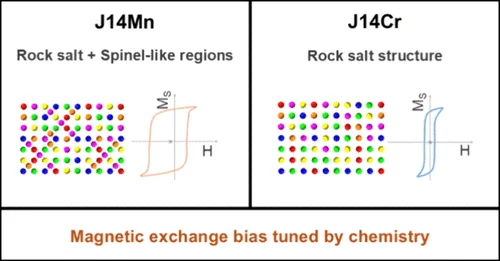
Abstract: Alloying is an age-old strategy for synthesizing materials with enhanced properties. Recently, multicomponent systems such as high-entropy oxides have garnered widespread attention due to their tunable and often superior properties compared to their constituent oxides. Here, we study the local structural and chemical nuances of six-component (Mg0.167Co0.167Ni0.167Cu0.167Zn0.167Mn0.167)O and (Mg0.167Co0.167Ni0.167Cu0.167Zn0.167Cr0.167)O thin films. The Mn-alloyed thin film exhibits a higher exchange bias and greater magnetic frustration compared with the Cr-containing thin film. Scanning/transmission electron microscopy investigations reveal that the Mn-alloyed thin film exhibits the coexistence of rock salt and spinel-like regions, unlike the single-phase rock salt structure observed in the Cr-alloyed thin film. Electron energy loss spectroscopy indicates changes in Co and Mn valences within the Mn-containing thin film, suggesting the presence of mixed-valence states, which are further confirmed by X-ray absorption spectroscopy measurements. These observations are further validated by cation-site-preference energy calculations using density functional theory. Our results demonstrate how the chemistry, site occupations, and cation valences result in pronounced changes in the overall properties of high-entropy oxides.

Read more at Journal of the American Chemical Society

Filed Under: Publications Tagged With: high entropy, John T. Heron, magnetism, Matt Webb, thin film

New Publication! “Historical Foundation and Practical Guideline for Ferroelectric Switching Kinetic Studies”

May 15, 2026 By Avery-Ryan Ansbro

Abstract: Electrical measurements of ferroelectric switching kinetics are widely used to probe the dynamics of polarization reversal, yet the influence of the measurement circuit is often underappreciated. In this paper, we show that the interplay between ferroelectric capacitors and circuit elements produces distorted, time-dependent voltage waveforms across the device, particularly in the sub-ns regime. We examine how these circuit contributions affect polarization transients extracted from PUND measurements. The resulting distortions scale with supply voltage, capacitor dimensions, and lumped circuit elements, but are not accounted for in conventional experimental analyses or analytical model fitting. We then critically assess existing nucleation and growth models and show that neglecting the time-varying voltage profile can lead to unphysical interpretations of switching kinetics, most notably in the extracted growth dimensionality represented by the Avrami exponent. Finally, we outline guidelines for future studies, emphasizing the need for direct voltage monitoring and circuit-aware de-embedding, as well as modeling frameworks that incorporate voltage-dependent nucleation and growth rates based on intrinsic material parameters.

Read more at Advanced Functional Materials

Filed Under: Publications Tagged With: ferroelectric, John T. Heron, Pat Kezer, Review, Yi Liang

New Publication! “Intertwinded Polar, Chiral, and Ferro-Rotational Orders in a Homo-Ferro-Rotational Insulator”

May 12, 2026 By Avery-Ryan Ansbro

Abstract: Intertwined orders refer to strongly coupled and mutually dependent orders that coexist in correlated electron systems, often underpinning key physical properties of the host materials. Among them, polar, chiral, and ferro-rotational orders have been theoretically known to form a closed set of intertwined orders. However, experimental investigation into their mutual coupling and physical consequences has remained elusive. In this work, we employ the polar-chiral insulator Ni3TeO6 as a platform and utilize a multimodal optical approach to directly probe and reveal the intertwining among polarity, chirality, and ferro-rotational order. We demonstrate how their coupling governs the formation of domains and dictates the nature of domain walls. Within the domains, we identify spatial inversion symmetry as the operation connecting two domain states of opposite polarity and chirality, with a homo-ferro-rotational state serving as the prerequisite for these interlocked configurations. At the domain walls, we observe a pronounced enhancement of in-plane polarization accompanied by a suppression of chirality. By combining with Ginzburg-Landau theory within the framework of a preexisting homo-ferro-rotational background, we uncover the emergence of mixed Néel- and Bloch-type domain walls. Our findings highlight the critical role of intertwined orders in defining domain and domain-wall characteristics and open pathways for domain switching and domain-wall control via intertwined order parameters.

Read more at Physical Review X

Filed Under: Publications Tagged With: ferromagnetism, John T. Heron, magnetism, Tony Chiang

New Publication! “Toward Determination of the Critical Breakdown Field in Rutile Sn1-xGexO2 Alloys”

March 20, 2026 By Avery-Ryan Ansbro

Abstract: The high-field electronic transport characteristics of ultra-wide bandgap (UWBG) rutile Sn1-xGexO2 alloys have been investigated through high-voltage measurements using lateral metal–semiconductor–metal (MSM) structures. Undoped Sn1-xGexO2 thin films with a Ge composition of x ≈ 0.70 were epitaxially grown on c-plane sapphire substrates via pulsed-laser deposition at 650°C. MSM structures were fabricated using Pt contacts with contact spacings ranging from 0.5 to 2.7 μm to probe the voltage-dependent transport behavior under high electric fields. The best devices demonstrated the ability to sustain applied voltages approaching 900 V prior to breakdown. Electrostatic simulations were used to evaluate the electric field distribution in the channel for the varying gap spacings and showed that the electric field in the channel is roughly three-fourths of the applied voltage divided by the contact spacing, leading to an estimate of the critical breakdown field in the range of 7.0 ± 1.4 MV/cm. These results are encouraging that UWBG Sn1-xGexO2 alloys could have potential for applications in high-power electronics.

Read more at Physica Status Solidi a

Filed Under: Publications Tagged With: John T. Heron, publications, thin film, ultrawide band gap, Yu Zheng

  • 1
  • 2
  • 3
  • …
  • 24
  • Next Page »

News

  • New Publication! “Ferroelectric Dynamic-Field-Driven Nucleation and Growth Model for Predictive Materials-To-Circuit Co-Design” June 13, 2026
  • New Publication! “Evidence of Local Structural Variations and Their Influence on Magnetic Properties in Mn- and Cr-Containing High-Entropy Oxide Thin Films Using Electron Microscopy” June 3, 2026
  • New Publication! “Historical Foundation and Practical Guideline for Ferroelectric Switching Kinetic Studies” May 15, 2026

Subscribe to Blog via Email

Enter your email address to subscribe to this blog and receive notifications of new posts by email.

About

Our research is at the intersection of multiple disciplines, drawing on principles and methodologies from materials science, chemistry, physics, and electrical engineering. Our mission is to pioneer … Read More

News

New Publication! “Ferroelectric Dynamic-Field-Driven Nucleation and Growth Model for Predictive Materials-To-Circuit Co-Design”

June 13, 2026 By Avery-Ryan Ansbro

New Publication! “Evidence of Local Structural Variations and Their Influence on Magnetic Properties in Mn- and Cr-Containing High-Entropy Oxide Thin Films Using Electron Microscopy”

June 3, 2026 By Avery-Ryan Ansbro

Contact

Ferroelectronics Lab
Address: 2030 H.H. Dow

T: (734) 763-6914
E: jtheron@umich.edu
  • Email

Ferroelectronics Lab · Copyright © 2026 · Website by Super Heron Support

Loading Comments...