Ferroelectronics Lab

Understanding and utilizing non-volatile properties of materials

  • About the Lab
  • People
  • Research
  • Publications
  • Support
  • Facilities
  • News

New Publication! “Endotaxial Stabilization of 2D 1T-TaS2 Charge Density Waves via In-Situ Electrical Current Biasing”

July 31, 2025 By Avery-Ryan Ansbro

Abstract: 1T-TaS2 is a layered, two-dimensional material which is host to several charge density wave (CDW) states with three distinct phases: an insulating commensurate (C) phase and the metallic nearly-commensurate (NC) and incommensurate (IC) phases [1-3]. CDW phase selection can be achieved via biasing, making 1T-TaS2 an attractive candidate for device applications [4-6]. The insulating C phase, however, only forms below ∼180 K [1, 7] for bulk 1T-TaS2 and even lower for thin flakes [5], leaving the metal-insulator transition unreachable for room temperature devices.

Recent work has shown endotaxial heterostructures of 2H-TaS2/1T-TaS2 can stabilize 2D C-CDW states in the twinned commensurate (tC) phase at room temperature with a single metal-insulator transition at ∼350 K [3, 8], paving the way for devices operable at room temperature. Previously, this phase has been realized by directly heating 1T-TaS2 past its polytype transition for a few minutes and then cooling it back to room temperature [3, 8].

Here, we show that the tC-CDW state can be synthesized electronically via current. Using an in-house built transmission electron microscopy (TEM) biasing holder, we can source current through exfoliated 1T-TaS2 flakes allowing us to drive and observe the polytype conversion in both real and reciprocal space in-situ. For sufficiently thin flakes, a current of around 210 µA/µm2 is enough to switch from the NC phase to the IC phase and back again. Upon sourcing higher currents of around 750 µA/µm2 the normal NC to IC transition is observed before seeing polytype conversion occur. Holding at this current for around 30 seconds longer is enough to stabilize the tC-CDW phase at room temperature. Similarly to the NC-IC transition, we can switch between the tC and IC phases of this new endotaxial structure by sourcing current through the sample. Using in-situ TEM we can correlate a polytype transition and the associated tC-CDW formation through electrical signatures. Further, this conversion is more localized compared to heating the sample in bulk.

In summary, we report current driven stabilization of 2D CDWs in 1T-TaS2 in and characterize the electronic switching of the NC to IC transition via in-situ TEM.

Read more at Microscopy and Microanalysis

Filed Under: Publications Tagged With: 2D material, device, John T. Heron, publications, Tony Chiang

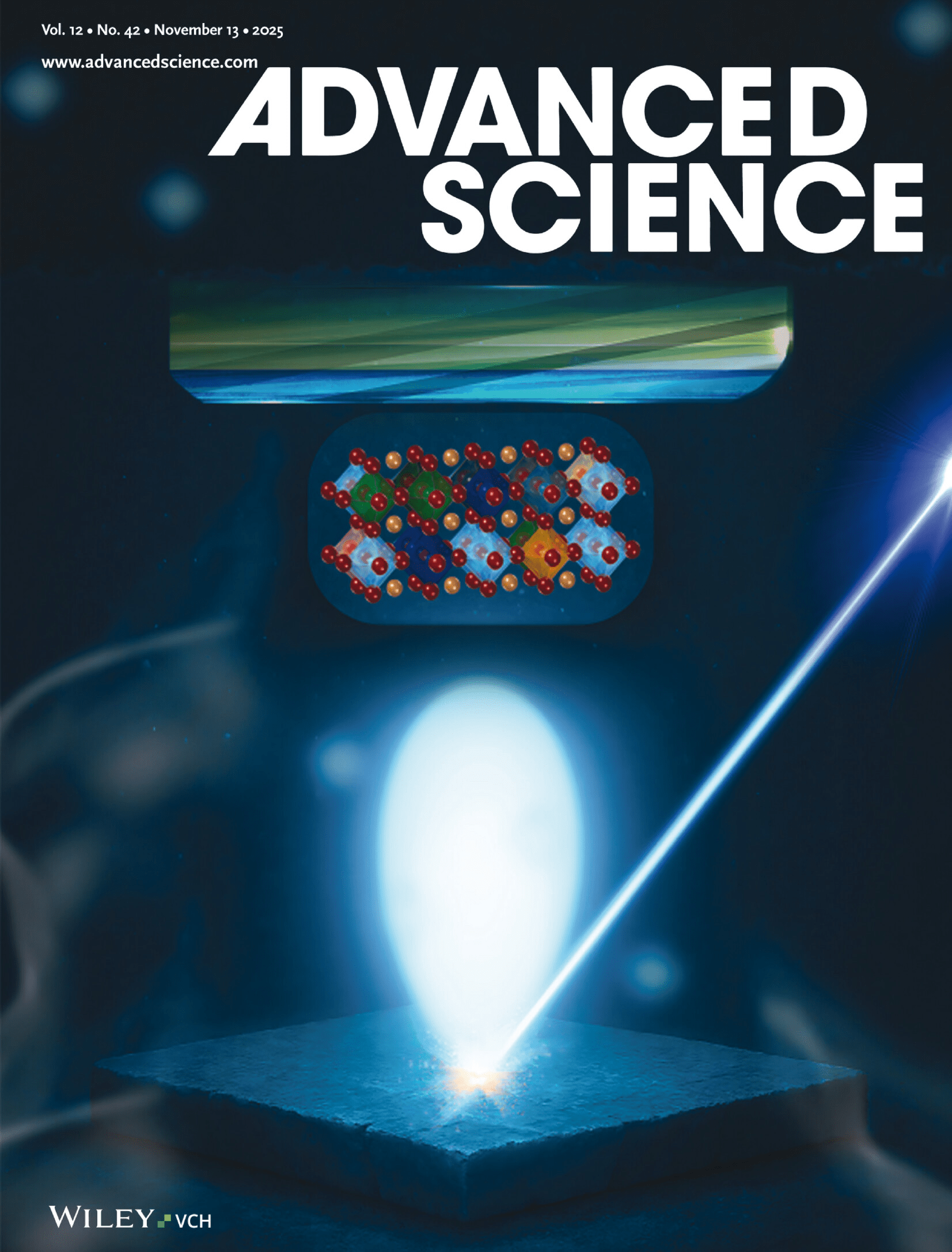
New Publication! “Chemically-Disordered Transparent Conductive Perovskites With High Crystalline Fidelity”

July 18, 2025 By Avery-Ryan Ansbro

Abstract: This manuscript presents a working model linking chemical disorder and transport properties in correlated-electron perovskites with high-entropy formulations and a framework to actively design them. This work demonstrates this new learning in epitaxial Srx(Ti,Cr,Nb,Mo,W)O3 thin films that exhibit exceptional crystalline fidelity despite a diverse chemical formulation where most B-site species are highly misfit with respect to valence and radius. X-ray diffraction, X-ray photoelectron spectroscopy, and transmission electron microscopy confirm a unique combination of chemical disorder and structural perfection in thin and thick epitaxial layers. This combination produces an optical transparency window that surpasses that of the constituent end-members in the UV and IR, while maintaining relatively low electrical resistivity. This work addresses the computational challenges of modeling such systems and investigate short-range ordering using cluster expansion. These results showcase that unusual d-metal combinations access an expanded property design space that is predictable using end-member characteristics and their interactions– though unavailable to them– thus offering performance advances in optical, high-frequency, spintronic, and quantum devices.

Read more at Advanced Science

Filed Under: Publications Tagged With: high entropy, John T. Heron, Pat Kezer, perovskite, publications

New Publication! “Engineering antiferromagnetic magnon bands through interlayer spin pumping”

March 28, 2025 By Avery-Ryan Ansbro

Abstract: Spin pumping, a central phenomenon in spintronics used to source pure spin currents, is best understood in collinear magnetic multilayers. There is not yet a unified Landau-Lifshitz-Gilbert (LLG) theory that captures the fieldlike and dampinglike torques in a generic noncollinear magnetic multilayer. Here, we theoretically expand the LLG phenomenology to incorporate both dynamic fieldlike and dampinglike torques arising from spin pumping within noncollinear magnetic materials. We find that often overlooked dynamic fieldlike torques are capable of unveiling inversion asymmetries present in magnetic multilayers. Consequently, spin pumping can be used to lift the spectral degeneracy between various magnon modes in noncollinear antiferromagnets. We experimentally confirm this magnon-magnon interaction in a synthetic antiferromagnetic tetralayer, which has highly noncollinear magnetization configurations when under the influence of an external field. Thus, we demonstrate how spin pumping can facilitate a magnon-magnon interaction, significantly expanding how magnonic interactions can be engineered into antiferromagnets and magnetic metamaterials.

Read more at Physics Review Applied

Filed Under: Publications Tagged With: John T. Heron, magnetism, Peter Meisenheimer, publications

New Publication! “Polydopamine-Assisted Electroless Deposition of Magnetic Functional Coatings for 3D-Printed Microrobots”

January 31, 2025 By Avery-Ryan Ansbro

Abstract: Magnetic microrobots are attractive tools for operation in confined spaces due to their small size and untethered wireless operation, particularly in biomedical and environmental applications. Over years of development, many microrobot fabrication methods have been developed; however, they typically require costly specialized physical vapor deposition (PVD) vacuum instrumentation and present homogeneity and conformality coating problems (especially in complex 3D structures). Herein, a solution-based polydopamine (PDA)-assisted electroless deposition method is developed to deposit a superparamagnetic nickel thin film on microrobots. The multilayered functional film design comprises PDA as an adhesive primer and reducing agent, silver nanoclusters as catalysts, and a nickel magnetic top film, all deposited in a batch solution-based process on glass and 3D-printed polymer substrates. This multilayer magnetic coating is implemented and demonstrated in three magnetic microrobot archetypes, including arbitrarily-shaped active particles, microrollers, and helical swimming microrobots, each using distinct actuation working mechanisms. Due to the material-independent interfacial adhesive properties of PDA, this multilayer functionalization strategy can open up new magnetic microrobot fabrication schemes with a broad compatibility with materials and structures (including complex 3D-printed polymer microstructures) and without the need for and limitations of PVD coating approaches.

Read more on Advanced Intelligent Systems

Filed Under: Publications Tagged With: John T. Heron, magnetism, Microbots, organic

New Publication! “Geometric effects in the measurement of the remanent ferroelectric polarization at the nanoscale” 

January 14, 2025 By Avery-Ryan Ansbro

Abstract: A resurgence of research on ferroelectric materials has recently occurred due to their potential to enhance the performance of memory and logic. For the design and commercialization of such technologies, it is important to understand the physical behavior of ferroelectrics and the interplay with device size, geometry, and fabrication processes. Here, we report a study of geometric factors that can influence the measurement of the remanent ferroelectric polarization, an important measurement for understanding wakeup, retention, and endurance in ferroelectric technologies. The areal size scaling of W/Hf0.5Zr0.5O2/W capacitors is compared in two typical structures: an island top electrode with a continuous ferroelectric layer and an island top electrode/ferroelectric layer (etched ferroelectric layer). Error in the evaluation of the switched area leads to anomalous scaling trends and increasing apparent remanent polarization as capacitor sizes decrease, most strongly in continuous ferroelectric layer capacitors. Using TEM and electric field simulations, this is attributed to two effects: a processing artifact from ion milling that creates a foot on the top electrode and a fringe electric field penetrating outside of the capacitor area. With the correction of the switching area, the 2Pr for both samples agree (∼32 μC cm−2) and is invariant in the capacitor sizes used (down to 400 nm diameter). Our work demonstrates that the determination of the actual capacitor structure and local electric field is needed to evaluate the intrinsic ferroelectric behavior at the nanoscale.

Read more on Applied Physics Letters

Filed Under: Publications Tagged With: device, ferroelectric, publications, Tony Chiang

  • « Previous Page
  • 1
  • 2
  • 3
  • 4
  • …
  • 23
  • Next Page »

News

  • New Publication! “Signatures of quantum spin liquid state and unconventional transport in thin film TbInO3” October 31, 2025
  • Tony Chiang Defends His Thesis, Earning a PhD! Congratulations Tony! August 19, 2025
  • New Publication! Sub-100 Ω/□ sheet resistance of GaN HEMT with ScAlN barrier August 10, 2025

Subscribe to Blog via Email

Enter your email address to subscribe to this blog and receive notifications of new posts by email.

About

Our research is at the intersection of multiple disciplines, drawing on principles and methodologies from materials science, chemistry, physics, and electrical engineering. Our mission is to pioneer … Read More

News

New Publication! “Signatures of quantum spin liquid state and unconventional transport in thin film TbInO3”

October 31, 2025 By Avery-Ryan Ansbro

Tony Chiang Defends His Thesis, Earning a PhD! Congratulations Tony!

August 19, 2025 By Avery-Ryan Ansbro

Contact

Ferroelectronics Lab
Address: 2030 H.H. Dow

T: (734) 763-6914
E: jtheron@umich.edu
  • Email

Ferroelectronics Lab · Copyright © 2025 · Website by Super Heron Support