Ferroelectronics Lab

Understanding and utilizing non-volatile properties of materials

  • About the Lab
  • People
  • Research
  • Publications
  • Support
  • Facilities
  • News

Advanced Science Showcases Work on Their Cover Page

November 18, 2025 By Avery-Ryan Ansbro

“Chemically-Disordered Transparent Conductive Perovskites With High Crystalline Fidelity,” a publication from July 2025 with strong contributions from Pat Keezer, gains attention this month. A graphical abstract artistically describing the work was used on the cover of volume 12, issue 42 of Advanced Science.

“A pulsed laser generates a high-energy plasma plume that quenches and kinetically arrests a high-symmetry, high-entropy, chemically disordered perovskite thin film on a substrate, yielding a material that is simultaneously conductive and transparent. This cover highlights the power of pulsed laser deposition and fast quenching to realize such phases with high crystalline fidelity.” See Advanced Science for more information.

Orignial Abstract: This manuscript presents a working model linking chemical disorder and transport properties in correlated-electron perovskites with high-entropy formulations and a framework to actively design them. This work demonstrates this new learning in epitaxial Srx(Ti,Cr,Nb,Mo,W)O3 thin films that exhibit exceptional crystalline fidelity despite a diverse chemical formulation where most B-site species are highly misfit with respect to valence and radius. X-ray diffraction, X-ray photoelectron spectroscopy, and transmission electron microscopy confirm a unique combination of chemical disorder and structural perfection in thin and thick epitaxial layers. This combination produces an optical transparency window that surpasses that of the constituent end-members in the UV and IR, while maintaining relatively low electrical resistivity. This work addresses the computational challenges of modeling such systems and investigate short-range ordering using cluster expansion. These results showcase that unusual d-metal combinations access an expanded property design space that is predictable using end-member characteristics and their interactions – though unavailable to them – thus offering performance advances in optical, high-frequency, spintronic, and quantum devices.

Read more at Advanced Science

Filed Under: Awards, Publications Tagged With: Cover, high entropy, John T. Heron, Pat Kezer, thin film

Intel Awards John T. Heron and lab with Outstanding Researcher Award!

July 31, 2025 By Avery-Ryan Ansbro

Once a year, Intel presents an award acknowledging work that makes “a significant impact on future technology” and “celebrates exceptional achievements made through Intel sponcered research.” John T. Heron is among the 10 researchers who have recieved this distinguished award.

“The research team demonstrated ultrafast switching of La-doped BiFeO3 ferroelectric capacitors, developed novel metrologies to measure polarization dynamics at nanoscale, demonstrated modeling frameworks to understand the effect of key physical processes such as domain nucleation, growth, and circuit limits on the switching process, and determined a new regime of energy-delay scaling behavior relevant for computing technologies. Furthermore, the researchers developed novel materials critical for accelerating magneto-electric spin-orbit (MESO) device development to deliver target specifications, such as high entropy perovskite oxides with large spin Hall efficiency and resistivity as well as double perovskite ferromagnet layers epitaxially compatible with La-doped BiFeO3.”

Congratulations to both John and the remainder of the research team who supported this achievement! Read more on Intel’s website if you are interested about this achievement.

Filed Under: Awards Tagged With: award, high entropy, intel, John T. Heron, magnetism, MESO

New Publication! “Investigating Vibrational Modes in High Entropy Oxides using Electron Energy Loss Spectroscopy”

July 31, 2025 By Avery-Ryan Ansbro

Abstract: The quest for novel materials with enhanced properties is ongoing. High entropy oxides (HEOs) have transformed material design by providing a vast compositional space and remarkable property tunability. These are multicomponent systems that consist of five or more cations randomly distributed within a solid solution. Since their discovery in 2015, HEOs have garnered significant attention for their potential applications such as ionic conductors, magnetic materials, ferroelectrics, thermoelectrics, and various other functional materials [1-3]. A notable property observed in HEOs is low thermal conductivity [3]. This is attributed to their enhanced phonon scattering because of the presence of local ionic charge disorder [4]. As the lattice vibrations, i.e. the phonon modes play a crucial in understanding the thermal conductivity of a material, it is necessary to investigate the phonons in HEOs.

The vibrational response of materials can be measured using Fourier Transform Infrared Spectroscopy (FTIR), neutron scattering, or Raman spectroscopy for bulk materials [5]. However, there is a need to probe the phonon modes at the nanoscale resolution to better understand the role of microstructural inhomogeneities or interfaces. With advancements in monochromators and spectrometers, Scanning/Transmission Electron Microscopy combined with Electron Energy Loss Spectroscopy (EELS) has now become an ideal tool for probing the phonon dynamics at the atomic scale. Recently, energy resolution in advanced electron microscopes have improved to 4.2meV, expanding the applications of STEM-EELS to probe phonons, excitons, band gaps, and more [6].

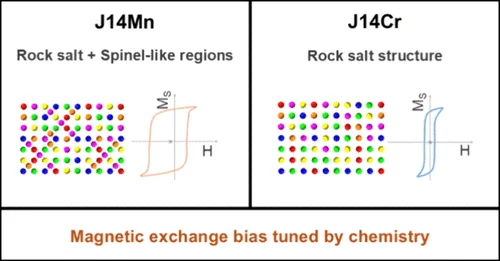
In this study, we utilize ultra-high energy resolution STEM-EELS combined with theoretical calculations to investigate the vibrational modes of the prototypical HEO called J14: (Mg0.2Co0.2Ni0.2Cu0.2Zn0.2)O, as well as six component HEO thin films (J14+Mn and J14+Cr). These films are grown on MgO substrates using Pulsed Laser Deposition (PLD). Due to the presence of aliovalent cations, local structural variations are observed in J14Mn thin film [7]. Figure 1 shows the phonon spectra of J14Cr HEO in comparison to the MgO substrate, acquired in the dark-field EELS geometry (to probe impact phonon scattering and thus study the localized vibrational response of the system at the atomic scale [8]). The phonon spectrum of J14Cr exhibits a peak around 18 meV, which is not observed in the parent oxide (MgO). Between 40 meV and 70 meV, MgO shows a peak around 48 meV, while J14Cr has a peak around 60 meV, indicating a blue shift compared to the MgO peak. We use FTIR and theoretical analysis to investigate the origin of spectral changes and assign the corresponding phonon modes. This investigation focuses on understanding the influence of composition on the phonon resonances in HEOs. Additionally, the variation in vibrational properties resulting from local structural nuances will also be explored using STEM-EELS data [9].

Read more at Microscopy and Microanalysis

Filed Under: Publications Tagged With: high entropy, John T. Heron, Matt Webb, thin film

New Publication! “Endotaxial Stabilization of 2D 1T-TaS2 Charge Density Waves via In-Situ Electrical Current Biasing”

July 31, 2025 By Avery-Ryan Ansbro

Abstract: 1T-TaS2 is a layered, two-dimensional material which is host to several charge density wave (CDW) states with three distinct phases: an insulating commensurate (C) phase and the metallic nearly-commensurate (NC) and incommensurate (IC) phases [1-3]. CDW phase selection can be achieved via biasing, making 1T-TaS2 an attractive candidate for device applications [4-6]. The insulating C phase, however, only forms below ∼180 K [1, 7] for bulk 1T-TaS2 and even lower for thin flakes [5], leaving the metal-insulator transition unreachable for room temperature devices.

Recent work has shown endotaxial heterostructures of 2H-TaS2/1T-TaS2 can stabilize 2D C-CDW states in the twinned commensurate (tC) phase at room temperature with a single metal-insulator transition at ∼350 K [3, 8], paving the way for devices operable at room temperature. Previously, this phase has been realized by directly heating 1T-TaS2 past its polytype transition for a few minutes and then cooling it back to room temperature [3, 8].

Here, we show that the tC-CDW state can be synthesized electronically via current. Using an in-house built transmission electron microscopy (TEM) biasing holder, we can source current through exfoliated 1T-TaS2 flakes allowing us to drive and observe the polytype conversion in both real and reciprocal space in-situ. For sufficiently thin flakes, a current of around 210 µA/µm2 is enough to switch from the NC phase to the IC phase and back again. Upon sourcing higher currents of around 750 µA/µm2 the normal NC to IC transition is observed before seeing polytype conversion occur. Holding at this current for around 30 seconds longer is enough to stabilize the tC-CDW phase at room temperature. Similarly to the NC-IC transition, we can switch between the tC and IC phases of this new endotaxial structure by sourcing current through the sample. Using in-situ TEM we can correlate a polytype transition and the associated tC-CDW formation through electrical signatures. Further, this conversion is more localized compared to heating the sample in bulk.

In summary, we report current driven stabilization of 2D CDWs in 1T-TaS2 in and characterize the electronic switching of the NC to IC transition via in-situ TEM.

Read more at Microscopy and Microanalysis

Filed Under: Publications Tagged With: 2D material, device, John T. Heron, publications, Tony Chiang

New Publication! “Chemically-Disordered Transparent Conductive Perovskites With High Crystalline Fidelity”

July 18, 2025 By Avery-Ryan Ansbro

Abstract: This manuscript presents a working model linking chemical disorder and transport properties in correlated-electron perovskites with high-entropy formulations and a framework to actively design them. This work demonstrates this new learning in epitaxial Srx(Ti,Cr,Nb,Mo,W)O3 thin films that exhibit exceptional crystalline fidelity despite a diverse chemical formulation where most B-site species are highly misfit with respect to valence and radius. X-ray diffraction, X-ray photoelectron spectroscopy, and transmission electron microscopy confirm a unique combination of chemical disorder and structural perfection in thin and thick epitaxial layers. This combination produces an optical transparency window that surpasses that of the constituent end-members in the UV and IR, while maintaining relatively low electrical resistivity. This work addresses the computational challenges of modeling such systems and investigate short-range ordering using cluster expansion. These results showcase that unusual d-metal combinations access an expanded property design space that is predictable using end-member characteristics and their interactions– though unavailable to them– thus offering performance advances in optical, high-frequency, spintronic, and quantum devices.

Read more at Advanced Science

Filed Under: Publications Tagged With: high entropy, John T. Heron, Pat Kezer, perovskite, publications

  • 1
  • 2
  • Next Page »

News

  • Advanced Science Showcases Work on Their Cover Page November 18, 2025
  • New Publication! “Signatures of quantum spin liquid state and unconventional transport in thin film TbInO3” October 31, 2025
  • Tony Chiang Defends His Thesis, Earning a PhD! Congratulations Tony! August 19, 2025

Subscribe to Blog via Email

Enter your email address to subscribe to this blog and receive notifications of new posts by email.

About

Our research is at the intersection of multiple disciplines, drawing on principles and methodologies from materials science, chemistry, physics, and electrical engineering. Our mission is to pioneer … Read More

News

Advanced Science Showcases Work on Their Cover Page

November 18, 2025 By Avery-Ryan Ansbro

New Publication! “Signatures of quantum spin liquid state and unconventional transport in thin film TbInO3”

October 31, 2025 By Avery-Ryan Ansbro

Contact

Ferroelectronics Lab
Address: 2030 H.H. Dow

T: (734) 763-6914
E: jtheron@umich.edu
  • Email

Ferroelectronics Lab · Copyright © 2025 · Website by Super Heron Support


Loading Comments...