Ferroelectronics Lab

Understanding and utilizing non-volatile properties of materials

  • About the Lab
  • People
  • Research
  • Publications
  • Support
  • Facilities
  • News

Advanced Science Showcases Work on Their Cover Page

November 18, 2025 By Avery-Ryan Ansbro

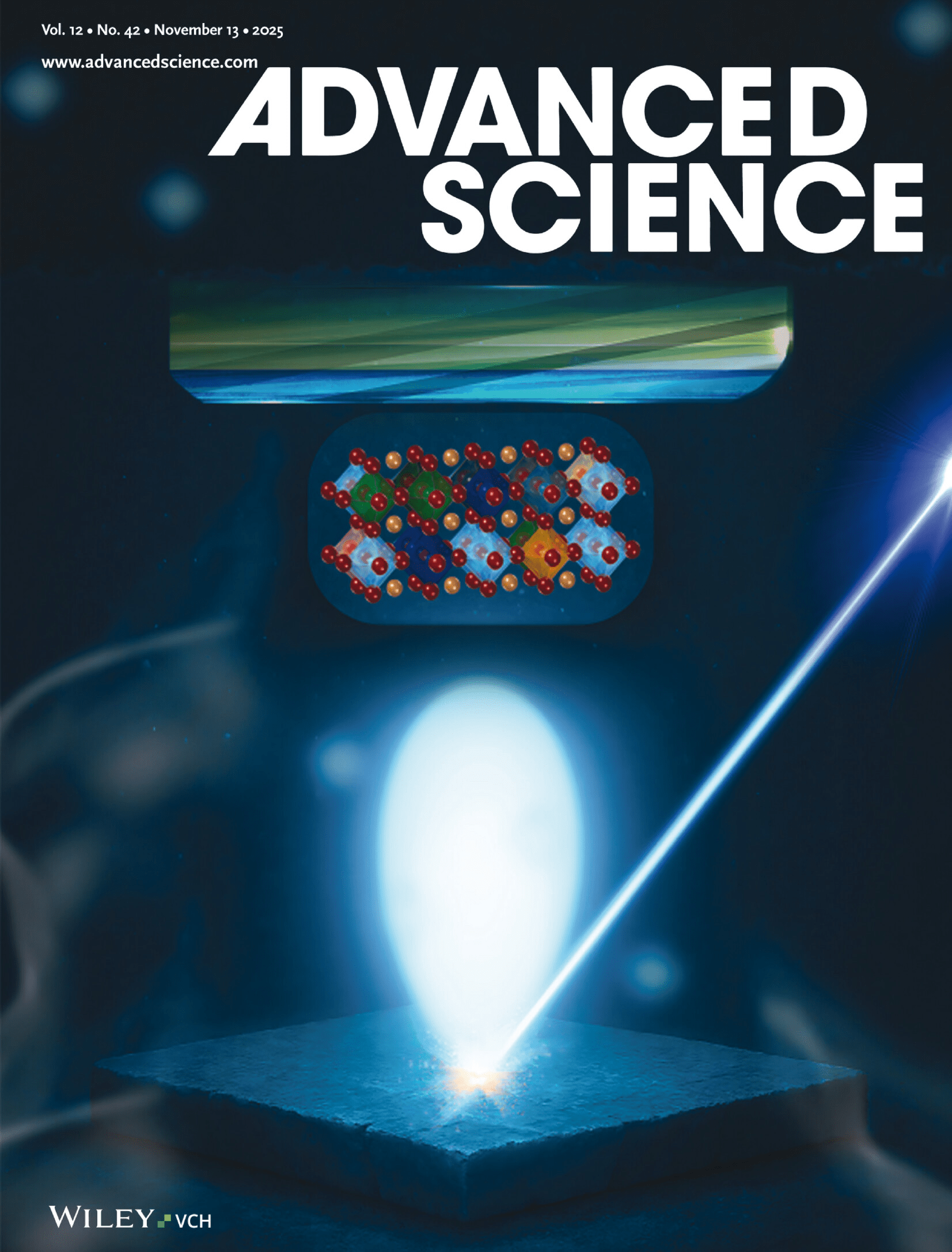
“Chemically-Disordered Transparent Conductive Perovskites With High Crystalline Fidelity,” a publication from July 2025 with strong contributions from Pat Keezer, gains attention this month. A graphical abstract artistically describing the work was used on the cover of volume 12, issue 42 of Advanced Science.

“A pulsed laser generates a high-energy plasma plume that quenches and kinetically arrests a high-symmetry, high-entropy, chemically disordered perovskite thin film on a substrate, yielding a material that is simultaneously conductive and transparent. This cover highlights the power of pulsed laser deposition and fast quenching to realize such phases with high crystalline fidelity.” See Advanced Science for more information.

Orignial Abstract: This manuscript presents a working model linking chemical disorder and transport properties in correlated-electron perovskites with high-entropy formulations and a framework to actively design them. This work demonstrates this new learning in epitaxial Srx(Ti,Cr,Nb,Mo,W)O3 thin films that exhibit exceptional crystalline fidelity despite a diverse chemical formulation where most B-site species are highly misfit with respect to valence and radius. X-ray diffraction, X-ray photoelectron spectroscopy, and transmission electron microscopy confirm a unique combination of chemical disorder and structural perfection in thin and thick epitaxial layers. This combination produces an optical transparency window that surpasses that of the constituent end-members in the UV and IR, while maintaining relatively low electrical resistivity. This work addresses the computational challenges of modeling such systems and investigate short-range ordering using cluster expansion. These results showcase that unusual d-metal combinations access an expanded property design space that is predictable using end-member characteristics and their interactions – though unavailable to them – thus offering performance advances in optical, high-frequency, spintronic, and quantum devices.

Read more at Advanced Science

Filed Under: Awards, Publications Tagged With: Cover, high entropy, John T. Heron, Pat Kezer, thin film

New Publication! “Signatures of quantum spin liquid state and unconventional transport in thin film TbInO3”

October 31, 2025 By Avery-Ryan Ansbro

Abstract: Quantum spin liquids, where the frustrated magnetic ground state hosts highly entangled spins resisting long-range order to 0 K, are exotic quantum magnets proximate to unconventional superconductivity and candidate platforms for topological quantum computing. Although several quantum spin liquid material candidates have been identified, thin films crucial for device fabrication and further tuning of properties remain elusive. Recently, hexagonal TbInO3 has emerged as a quantum spin liquid candidate which also hosts improper ferroelectricity and exotic high-temperature carrier transport. Here, we synthesize thin films of TbInO3 and characterize their magnetic and electronic properties. Our films present a highly frustrated magnetic ground state without long-range order to 0.4 K, consistent with bulk crystals. We further reveal a rich ferroelectric domain structure and unconventional non-local transport near room temperature, suggesting hexagonal TbInO3 as a promising candidate for realizing exotic magnetic and transport phenomena in epitaxial heterostructures.

Read more at Nature Communications

Filed Under: Publications Tagged With: ferroelectric, magnetism, quantum, thin film, Tony Chiang

New Publication! “Investigating Vibrational Modes in High Entropy Oxides using Electron Energy Loss Spectroscopy”

July 31, 2025 By Avery-Ryan Ansbro

Abstract: The quest for novel materials with enhanced properties is ongoing. High entropy oxides (HEOs) have transformed material design by providing a vast compositional space and remarkable property tunability. These are multicomponent systems that consist of five or more cations randomly distributed within a solid solution. Since their discovery in 2015, HEOs have garnered significant attention for their potential applications such as ionic conductors, magnetic materials, ferroelectrics, thermoelectrics, and various other functional materials [1-3]. A notable property observed in HEOs is low thermal conductivity [3]. This is attributed to their enhanced phonon scattering because of the presence of local ionic charge disorder [4]. As the lattice vibrations, i.e. the phonon modes play a crucial in understanding the thermal conductivity of a material, it is necessary to investigate the phonons in HEOs.

The vibrational response of materials can be measured using Fourier Transform Infrared Spectroscopy (FTIR), neutron scattering, or Raman spectroscopy for bulk materials [5]. However, there is a need to probe the phonon modes at the nanoscale resolution to better understand the role of microstructural inhomogeneities or interfaces. With advancements in monochromators and spectrometers, Scanning/Transmission Electron Microscopy combined with Electron Energy Loss Spectroscopy (EELS) has now become an ideal tool for probing the phonon dynamics at the atomic scale. Recently, energy resolution in advanced electron microscopes have improved to 4.2meV, expanding the applications of STEM-EELS to probe phonons, excitons, band gaps, and more [6].

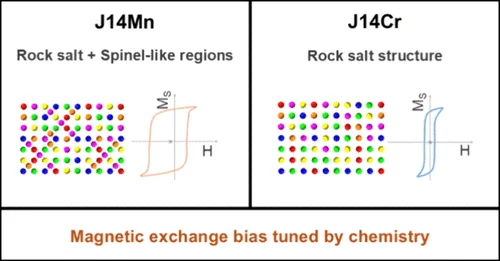
In this study, we utilize ultra-high energy resolution STEM-EELS combined with theoretical calculations to investigate the vibrational modes of the prototypical HEO called J14: (Mg0.2Co0.2Ni0.2Cu0.2Zn0.2)O, as well as six component HEO thin films (J14+Mn and J14+Cr). These films are grown on MgO substrates using Pulsed Laser Deposition (PLD). Due to the presence of aliovalent cations, local structural variations are observed in J14Mn thin film [7]. Figure 1 shows the phonon spectra of J14Cr HEO in comparison to the MgO substrate, acquired in the dark-field EELS geometry (to probe impact phonon scattering and thus study the localized vibrational response of the system at the atomic scale [8]). The phonon spectrum of J14Cr exhibits a peak around 18 meV, which is not observed in the parent oxide (MgO). Between 40 meV and 70 meV, MgO shows a peak around 48 meV, while J14Cr has a peak around 60 meV, indicating a blue shift compared to the MgO peak. We use FTIR and theoretical analysis to investigate the origin of spectral changes and assign the corresponding phonon modes. This investigation focuses on understanding the influence of composition on the phonon resonances in HEOs. Additionally, the variation in vibrational properties resulting from local structural nuances will also be explored using STEM-EELS data [9].

Read more at Microscopy and Microanalysis

Filed Under: Publications Tagged With: high entropy, John T. Heron, Matt Webb, thin film

New Publication! “Geometric defects induced by strain relaxation in thin film oxide superlattices.”

November 10, 2022 By Matt Webb

Abstract: Functional thin film superlattices with stability in extreme environments can lead to transformative performance in optical and thermal applications such as thermophotovoltaics. In this work, key issues associated with defects that prevent layer-by-layer growth in epitaxial, low-miscibility oxide superlattices are investigated. Layer protrusions, approximately 8 nm wide and 3 nm thick, arise from a strain relaxation mechanism in 8 nm bilayer superlattices of Ba(Zr0.5Hf0.5)O3/MgO and propagate through the subsequent superlattice layers forming an inverted pyramid structure that is spatially phase offset from the matrix. The density and size of these defects scales with the number of interfaces in the sample, indicating that surface roughness during growth is a significant factor in the formation of these defects. In situ high temperature transmission electron microscopy (1000 °C, in vacuo) measurement reveals that phase decomposition of Ba(Zr0.5Hf0.5)O3 and decoherence of the superlattice is nucleated by these defects. This work highlights that achieving optimum growth conditions is imperative to the synthesis of single-crystalline superlattices with sharp interfaces for optimized performance in extreme environments.

Full text available from Journal of Applied Physics.

Filed Under: Publications Tagged With: Matt Webb, thin film

New Publication! “Nanophotonic control of thermal emission under extreme temperatures in air”

September 29, 2022 By Matt Webb

Abstract: Nanophotonic materials offer spectral and directional control over thermal emission, but in high-temperature oxidizing environments, their stability remains low. This limits their applications in technologies such as solid-state energy conversion and thermal barrier coatings. Here we show an epitaxial heterostructure of perovskite BaZr0.5Hf0.5O3 (BZHO) and rocksalt MgO that is stable up to 1,100 °C in air. The heterostructure exhibits coherent atomic registry and clearly separated refractive-index-mismatched layers after prolonged exposure to this extreme environment. The immiscibility of the two materials is corroborated by the high formation energy of substitutional defects from density functional theory calculations. The epitaxy of immiscible refractory oxides is, therefore, an effective method to avoid prevalent thermal instabilities in nanophotonic materials, such as grain-growth degradation, interlayer mixing and oxidation. As a functional example, a BZHO/MgO photonic crystal is implemented as a filter to suppress long-wavelength thermal emission from the leading bulk selective emitter and effectively raise its cutoff energy by 20%, which can produce a corresponding gain in the efficiency of mobile thermophotovoltaic systems. Beyond BZHO/MgO, computational screening shows that hundreds of potential cubic oxide pairs fit the design principles of immiscible refractory photonics. Extending the concept to other material systems could enable further breakthroughs in a wide range of photonic and energy conversion applications.

Full text available from Nature Nanotechnology.

Filed Under: Publications Tagged With: Matt Webb, photonics, thin film

  • 1
  • 2
  • Next Page »

News

  • Advanced Science Showcases Work on Their Cover Page November 18, 2025
  • New Publication! “Signatures of quantum spin liquid state and unconventional transport in thin film TbInO3” October 31, 2025
  • Tony Chiang Defends His Thesis, Earning a PhD! Congratulations Tony! August 19, 2025

Subscribe to Blog via Email

Enter your email address to subscribe to this blog and receive notifications of new posts by email.

About

Our research is at the intersection of multiple disciplines, drawing on principles and methodologies from materials science, chemistry, physics, and electrical engineering. Our mission is to pioneer … Read More

News

Advanced Science Showcases Work on Their Cover Page

November 18, 2025 By Avery-Ryan Ansbro

New Publication! “Signatures of quantum spin liquid state and unconventional transport in thin film TbInO3”

October 31, 2025 By Avery-Ryan Ansbro

Contact

Ferroelectronics Lab
Address: 2030 H.H. Dow

T: (734) 763-6914
E: jtheron@umich.edu
  • Email

Ferroelectronics Lab · Copyright © 2025 · Website by Super Heron Support


Loading Comments...