Ferroelectronics Lab

Understanding and utilizing non-volatile properties of materials

  • About the Lab
  • People
  • Research
  • Publications
  • Support
  • Facilities
  • News
  • Memes

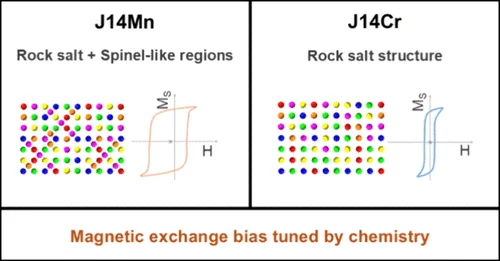
New Publication! “Evidence of Local Structural Variations and Their Influence on Magnetic Properties in Mn- and Cr-Containing High-Entropy Oxide Thin Films Using Electron Microscopy”

June 3, 2026 By Avery-Ryan Ansbro

Abstract: Alloying is an age-old strategy for synthesizing materials with enhanced properties. Recently, multicomponent systems such as high-entropy oxides have garnered widespread attention due to their tunable and often superior properties compared to their constituent oxides. Here, we study the local structural and chemical nuances of six-component (Mg0.167Co0.167Ni0.167Cu0.167Zn0.167Mn0.167)O and (Mg0.167Co0.167Ni0.167Cu0.167Zn0.167Cr0.167)O thin films. The Mn-alloyed thin film exhibits a higher exchange bias and greater magnetic frustration compared with the Cr-containing thin film. Scanning/transmission electron microscopy investigations reveal that the Mn-alloyed thin film exhibits the coexistence of rock salt and spinel-like regions, unlike the single-phase rock salt structure observed in the Cr-alloyed thin film. Electron energy loss spectroscopy indicates changes in Co and Mn valences within the Mn-containing thin film, suggesting the presence of mixed-valence states, which are further confirmed by X-ray absorption spectroscopy measurements. These observations are further validated by cation-site-preference energy calculations using density functional theory. Our results demonstrate how the chemistry, site occupations, and cation valences result in pronounced changes in the overall properties of high-entropy oxides.
Read more at Journal of the American Chemical Society

Filed Under: Publications Tagged With: high entropy, John T. Heron, magnetism, Matt Webb, thin film

New Publication! “Investigating Vibrational Modes in High Entropy Oxides using Electron Energy Loss Spectroscopy”

July 31, 2025 By Avery-Ryan Ansbro

Abstract: The quest for novel materials with enhanced properties is ongoing. High entropy oxides (HEOs) have transformed material design by providing a vast compositional space and remarkable property tunability. These are multicomponent systems that consist of five or more cations randomly distributed within a solid solution. Since their discovery in 2015, HEOs have garnered significant attention for their potential applications such as ionic conductors, magnetic materials, ferroelectrics, thermoelectrics, and various other functional materials [1-3]. A notable property observed in HEOs is low thermal conductivity [3]. This is attributed to their enhanced phonon scattering because of the presence of local ionic charge disorder [4]. As the lattice vibrations, i.e. the phonon modes play a crucial in understanding the thermal conductivity of a material, it is necessary to investigate the phonons in HEOs.

The vibrational response of materials can be measured using Fourier Transform Infrared Spectroscopy (FTIR), neutron scattering, or Raman spectroscopy for bulk materials [5]. However, there is a need to probe the phonon modes at the nanoscale resolution to better understand the role of microstructural inhomogeneities or interfaces. With advancements in monochromators and spectrometers, Scanning/Transmission Electron Microscopy combined with Electron Energy Loss Spectroscopy (EELS) has now become an ideal tool for probing the phonon dynamics at the atomic scale. Recently, energy resolution in advanced electron microscopes have improved to 4.2meV, expanding the applications of STEM-EELS to probe phonons, excitons, band gaps, and more [6].

In this study, we utilize ultra-high energy resolution STEM-EELS combined with theoretical calculations to investigate the vibrational modes of the prototypical HEO called J14: (Mg0.2Co0.2Ni0.2Cu0.2Zn0.2)O, as well as six component HEO thin films (J14+Mn and J14+Cr). These films are grown on MgO substrates using Pulsed Laser Deposition (PLD). Due to the presence of aliovalent cations, local structural variations are observed in J14Mn thin film [7]. Figure 1 shows the phonon spectra of J14Cr HEO in comparison to the MgO substrate, acquired in the dark-field EELS geometry (to probe impact phonon scattering and thus study the localized vibrational response of the system at the atomic scale [8]). The phonon spectrum of J14Cr exhibits a peak around 18 meV, which is not observed in the parent oxide (MgO). Between 40 meV and 70 meV, MgO shows a peak around 48 meV, while J14Cr has a peak around 60 meV, indicating a blue shift compared to the MgO peak. We use FTIR and theoretical analysis to investigate the origin of spectral changes and assign the corresponding phonon modes. This investigation focuses on understanding the influence of composition on the phonon resonances in HEOs. Additionally, the variation in vibrational properties resulting from local structural nuances will also be explored using STEM-EELS data [9].

Read more at Microscopy and Microanalysis

Filed Under: Publications Tagged With: high entropy, John T. Heron, Matt Webb, thin film

New Publication! “Conductive filament formation in the failure of Hf0.5Zr0.5O2 ferroelectric capacitors” 

January 13, 2025 By Avery-Ryan Ansbro

Abstract: Ferroelectric materials provide pathways to higher performance logic and memory technologies, with Hf0.5Zr0.5O2 being the most popular among them. However, critical challenges exist in understanding the material’s failure mechanisms to design long endurance lifetimes. In this work, dielectric failure due to repeated switching cycles, occurring through oxygen vacancy motion and leading to the formation of a conductive filament, is demonstrated. A field modified hopping barrier of ∼150–400 meV is observed, indicating a vacancy charge of 0.4–0.6e markedly different from the charge states predicted in the literature. After failure, the capacitor leakage current is high (∼25 mA) and constant with capacitor area, consistent with filament formation. Conductive atomic force microscopy measurements and field distribution simulations suggest a local failure mechanism consistent with filament formation along the boundary of the island capacitor due to an enhanced electric field.

Full text available at APL Materials

Filed Under: Publications Tagged With: device, ferroelectric, Matt Webb, publications, Tony Chiang

Matt defends his PhD dissertation! Congratulations Matt!

January 9, 2025 By Avery-Ryan Ansbro

On December 9th, Matt gave a great defense of his PhD dissertation, titled “Analysis of Phase Stability and Defect Mobility in Functional Oxides Exposed to Extreme Conditions“. In completing his work at the University of Michigan, he has accepted a position at Micron Technology. Excellent job! The Ferroelectronics Lab wishes you the very best luck in your future work!

Filed Under: Graduate Student Progress Tagged With: Disertation, Graduation, Matt Webb

New Publication! ” Local structure maturation in high entropy oxide (Mg,Co,Ni,Cu,Zn)1-x(Cr,Mn)xO thin films”

October 7, 2024 By Avery-Ryan Ansbro

Abstract: High entropy oxides (HEOs) have garnered much interest due to their available high degree of tunability. Here, we study the local structure of (MgNiCuCoZn)0.167(MnCr)0.083O, a composition based on the parent HEO (MgNiCuCoZn)0.2O. We synthesized a series of thin films via pulsed laser deposition at incremental oxygen partial pressures. X-ray diffraction shows lattice parameters to decrease with increased pO2 pressures until the onset of phase separation. X-ray absorption fine structure shows that specific atomic species in the composition dictate the global structure of the material as Cr, Co, and Mn shift to energetically favorable coordination with increasing pressure. Transmission electron microscopy analysis on a lower-pressure sample exhibits a rock salt structure, but the higher-pressure sample reveals reflections reminiscent of the spinel structure. In all, these findings give a more complete picture of how (MgNiCuCoZn)0.167(MnCr)0.083O forms with varying initial conditions and advances fundamental knowledge of cation behavior in high entropy oxides.

Full text available at The Journal of the American Ceramic Society

Filed Under: Publications Tagged With: high entropy, Matt Webb, publications

  • 1
  • 2
  • Next Page »

News

  • New Publication! “Evidence of Local Structural Variations and Their Influence on Magnetic Properties in Mn- and Cr-Containing High-Entropy Oxide Thin Films Using Electron Microscopy” June 3, 2026
  • New Publication! “Historical Foundation and Practical Guideline for Ferroelectric Switching Kinetic Studies” May 15, 2026
  • New Publication! “Intertwinded Polar, Chiral, and Ferro-Rotational Orders in a Homo-Ferro-Rotational Insulator” May 12, 2026

Subscribe to Blog via Email

Enter your email address to subscribe to this blog and receive notifications of new posts by email.

About

Our research is at the intersection of multiple disciplines, drawing on principles and methodologies from materials science, chemistry, physics, and electrical engineering. Our mission is to pioneer … Read More

News

New Publication! “Evidence of Local Structural Variations and Their Influence on Magnetic Properties in Mn- and Cr-Containing High-Entropy Oxide Thin Films Using Electron Microscopy”

June 3, 2026 By Avery-Ryan Ansbro

New Publication! “Historical Foundation and Practical Guideline for Ferroelectric Switching Kinetic Studies”

May 15, 2026 By Avery-Ryan Ansbro

Contact

Ferroelectronics Lab
Address: 2030 H.H. Dow

T: (734) 763-6914
E: jtheron@umich.edu
  • Email

Ferroelectronics Lab · Copyright © 2026 · Website by Super Heron Support

Loading Comments...